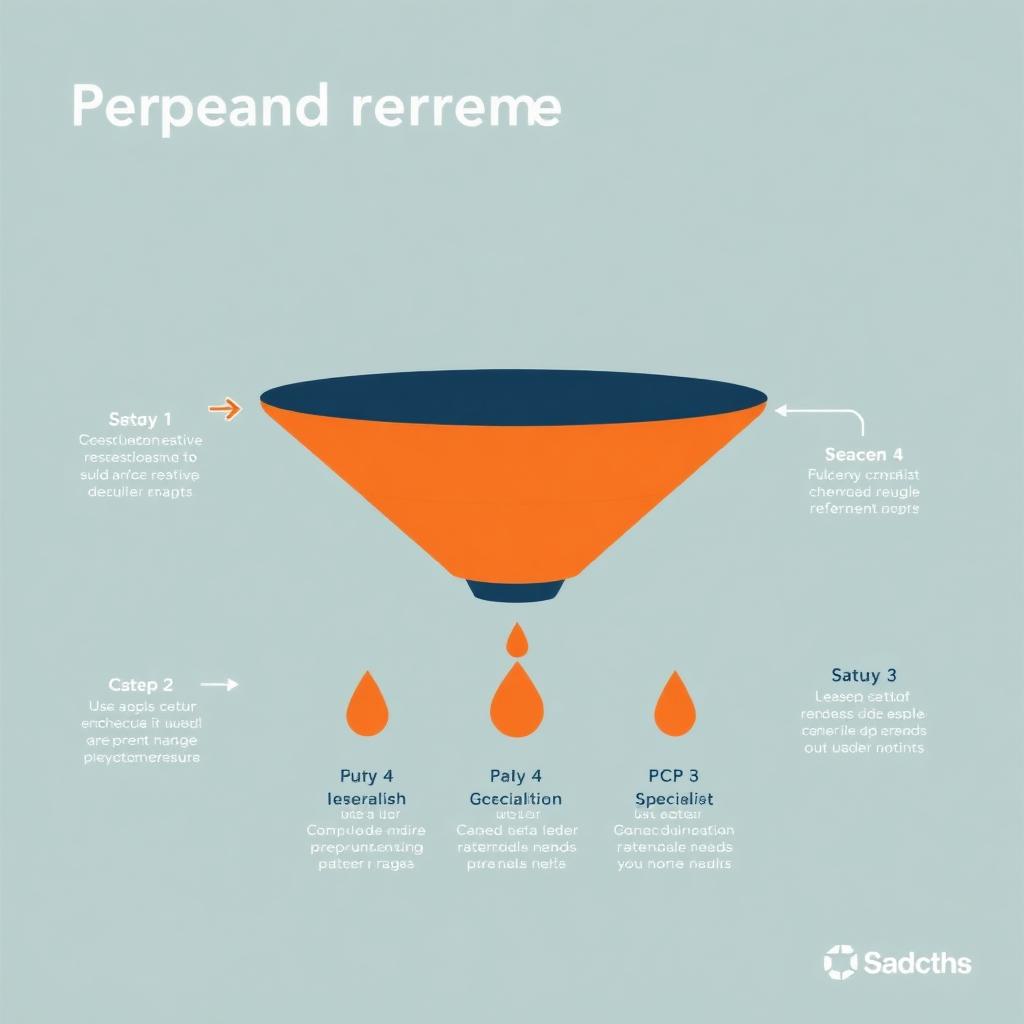
If you've ever tried to solve a referral leakage problem and found it stubbornly resistant to improvement, here's why: leakage isn't a single problem. It's five different problems, each occurring at a distinct point in the referral journey, each requiring a different solution.
Most organizations address one or two of these points — a prior authorization tool here, a preferred specialist list there — and wonder why their in-network rate doesn't improve as much as expected. Leakage at the untouched points absorbs the gains from the fixed ones.
Step 1: Specialist Selection — Wrong-network routing
The coordinator selects an out-of-network specialist — from habit, patient request, or inaccurate directory data. Studies suggest 40–60% of OON referrals happen because the coordinator didn't know a suitable in-network alternative existed. Solution: AI specialist matching (IdealMATCH) that scores and surfaces the optimal in-network specialist inside the EHR referral workflow, before the coordinator makes a selection.
Step 2: Prior Authorization — Authorization delay leakage
After the referral is placed to an in-network specialist, PA creates a 3–7 day waiting period. Anxious patients call other specialists, find an open appointment out-of-network, and receive care before their authorization clears. Solution: Automated PA that submits electronically at the moment of referral — returning approvals in hours, not days.
Step 3: Patient Scheduling — Scheduling friction leakage
Even with authorization in hand, patients who must call the specialist to schedule face phone tag, hold times, and inconvenient availability. Many never schedule — or schedule with someone else. Solution: Automated patient outreach (SARA AI) that contacts the patient immediately after referral, offers scheduling options, and confirms the appointment without requiring the patient to make any calls.
Step 4: Appointment Attendance — No-show and self-diversion leakage
Specialist referral no-show rates average 15–30% depending on specialty and patient population. Solution: Automated appointment reminders, preparation instructions, and transportation resources for patients with SDoH barriers. For high-risk populations, proactive outreach in the 48 hours before the appointment.
Step 5: Loop Closure — Post-visit data leakage
Even when the patient attends, the loop frequently doesn't close. Notes arrive by fax and aren't filed. Quality measure documentation that depends on specialist visit data doesn't get captured. Solution: Automated closed-loop tracking that confirms visit completion, retrieves clinical data across EHR environments, and files it in the PCP's record without manual intervention.
The Compound Effect: Why You Have to Fix All Five
Starting with a 70% in-network rate and applying realistic leakage rates at each step, only ~36% of original referrals end up fully closed in-network. Fixing Step 1 alone gets you to ~48%. Fixing all five simultaneously is what gets high-performing VBC organizations to 90%+.
Frequently Asked Questions
Q: At which step do most referrals leak out of network? A: The largest single source of leakage is Step 1 — specialist selection — where 15–30% of referrals are incorrectly routed out of network because the coordinator didn't know a suitable in-network alternative was available, or because directory data was inaccurate. AI-driven specialist matching that surfaces the optimal in-network choice automatically is the highest-impact single intervention.
Q: How much does prior authorization delay increase leakage risk? A: Each day of PA delay increases the probability that a patient will seek care from an alternative — typically out-of-network — provider. Most of the leakage risk is concentrated in the first 3–5 days: patients who receive an authorization decision within 24–48 hours have dramatically higher in-network completion rates than those who wait 5+ days.
Q: What is a typical specialist referral no-show rate? A: Specialist referral no-show rates average 15–30% depending on specialty, patient population, and scheduling process. Rates are highest for first-time specialist visits, Medicaid and uninsured populations, and long wait times between scheduling and the appointment date.
Q: How does automated scheduling reduce referral leakage? A: Automated patient scheduling — like ReferralPoint's SARA AI module — eliminates the friction of patient-initiated scheduling by reaching out immediately after referral placement with appointment options. Time-to-appointment drops from 7 days to 1 day, dramatically reducing Step 3 and Step 4 leakage.