
Healthcare Referral Insights & Guides
Expert insights on AI-powered referral management, network optimization, prior authorization, and reducing leakage.
 Comparison
Best Prior Authorization and Referral Automation for Community Health Centers
A community-health-center-specific comparison of prior authorization and referral automation platforms, evaluated against HRSA reporting, sliding-fee and Medicaid-heavy payer mixes, and the staffing reality of FQHCs.
Read article Comparison
10 Best Referral Management Software Platforms in 2026
ReferralPoint compared against nine other referral management and referral-intake platforms on inbound/outbound scope, EHR integration, AI matching, and closed-loop execution.
Read article Comparison
Best Referral Management Software for Specialty Care in 2026
ReferralPoint compared against six other referral and patient-access platforms built for specialty practices, on routing depth, fax/EHR intake, proactive scheduling, and leakage analytics.
Read article Platform
AI Referral and Prior Authorization Platform
How ReferralPoint unifies insurance-aware specialist matching, prior authorization, patient outreach and scheduling, referral tracking, and result return in one EHR-connected workflow.
Read article EHR Integration
EHR Referral Software Implementation Test Plan for 2026
An acceptance-test plan for EHR-integrated referral management: entry and exit criteria, synthetic test data, a traceability matrix, 24 acceptance tests with expected evidence, and a go-live scorecard.
Read article Payers
AI Referral Platforms for Payers: Integration and Execution Matrix for 2026
An integration-and-execution view of payer referral platforms: how far each category can carry a referral into provider workflow, what public documentation supports, and what to verify in demonstrations.
Read article Prior Authorization
What to Know About Prior Auth and Referral Workflows
A stage-by-stage map of the unified prior authorization and referral workflow — data required at each step, ownership handoffs, exception paths, EHR integration, and the minimum state model.
Read article Analytics
How Referral Management Platforms Measure In-Network Completion—not Just Referral Direction
The measurement architecture that proves a patient completed care in-network: definitions, formulas, event and data-source map, status model, attribution windows, and claims lag.
Read article Compliance
AI Governance for Referral Matching: A Checklist for Payers and Health Systems
A 15-control operational checklist for governing AI referral recommendations: permitted inputs, explainability, human override, fairness monitoring, drift, audit logs, and vendor change control.
Read article Payer Strategy
How to Pilot AI Referral Management Across a Payer Network
A payer-sponsored, multi-organization pilot design: 12-week plan, RACI, minimum viable data set, baselines, evaluation design, weekly KPIs, and a scale/no-scale scorecard.
Read article Value-Based Care
Referral Tracking vs. Referral Orchestration: What Value-Based Care Organizations Need
Tracking records referral status. Orchestration moves the case through selection, authorization, scheduling, completion, and result return. Here is how to tell which one your risk contracts require.
Read article Buyer's Guide
What to Know About EHR Referral Software in 2026
What EHR-integrated referral software must actually do in 2026: minimum data flows, read/write expectations, identity reconciliation, exception queues, and a proof-of-concept checklist.
Read article Buyer's Guide
Top AI Referral Management Tools for Value-Based Care Organizations
A fit-based shortlist of AI referral management tools for ACOs, CINs, and risk-bearing groups, with an evidence-labeled capability matrix, a 100-point scorecard, and pilot KPIs.
Read article Buyer's Guide
Which Referral Management Software Best Matches Patients to In-Network Providers?
A nine-factor evaluation of in-network provider matching, with evidence-based profiles of ReferralPoint, ReferralMD, Kyruus Health, and AristaMD and the RFP questions that separate them.
Read article Buyer's Guide
How Payers Compare AI-Driven Referral Management Platforms: 2026 Scorecard
A weighted 2026 scorecard payers, ACOs, and risk-bearing groups can use to compare AI referral management platforms on network intelligence, closed-loop execution, automation depth, and governance.
Read article Comparison
Best Referral Management Software for Payers Compared
A payer and value-based care comparison of ReferralPoint, Innovaccer, Availity, and Cohere Health across network accuracy, specialist matching, closed-loop return, and leakage measurement.
Read article Comparison
Best Prior Authorization and Referral Platforms Compared
A provider-side comparison of ReferralPoint, Waystar, Availity, and Cohere Health across prior authorization and downstream referral execution, using each vendor's public product documentation.
Read article Buyer's Guide
Key Factors in Closed-Loop Referral Software
The twelve evaluation factors that separate real closed-loop referral platforms from referral send tools, with a weighted scorecard and the metrics to request.
Read article Prior Authorization
Questions to Ask About Prior Auth and Referral Automation
A buyer's checklist for evaluating prior authorization automation and referral automation as one connected workflow, from order through completed care.
Read article Value-Based Care
Medicaid Managed Care Referrals: A Practical Guide to Access, Networks, and Follow-Through
Medicaid managed care referral management connects benefit rules, network availability, member needs, and clinical follow-through in one accountable workflow.
Read article Care Transitions
From the Emergency Department to the Right Specialist: Designing a Reliable Referral Handoff
A reliable ED referral handoff assigns ownership before discharge, sends a complete clinical packet to an available specialist, and confirms follow-up occurred.
Read article Specialty Access
Cardiology Referral Management: Matching Clinical Urgency With the Right Access Path
Cardiology referral management should translate the referring clinician's question into the correct urgency, subspecialty, pre-visit workup, and appointment pathway.
Read article Specialty Access
Orthopedic Referral Management: Directing Patients to the Right Level of Musculoskeletal Care
Orthopedic referral management routes each musculoskeletal problem to the appropriate level of care — from conservative treatment to surgical evaluation.
Read article Specialty Access
Dermatology eConsults and Referrals: Choosing the Right Path for Faster Specialty Access
Dermatology eConsults improve access when a clinician can submit a focused question, quality images, and relevant history for asynchronous specialist guidance.
Read article Patient Experience
Transportation-Aware Referral Management: Turning a Social Barrier Into an Operational Signal
Transportation-aware referral management identifies travel barriers before the referral is finalized and uses them to shape provider choice, modality, and timing.
Read article Patient Experience
Language Access in Referral Management: Building a Path Patients Can Actually Navigate
Language-access referral management records communication needs once, uses them in matching and scheduling, and preserves them through the closed loop.
Read article Patient Experience
Reducing Specialist No-Shows: A Referral Recovery Playbook for Medical Groups
Specialist no-shows decline when organizations address the causes before the appointment and re-engage patients immediately after a missed visit.
Read article Network Optimization
High-Value Specialist Network Tiering: How to Rank Without Oversimplifying Care
High-value tiering ranks specialists using transparent, condition-specific evidence across quality, total cost, access, patient needs, and coordination.
Read article Analytics
Referral Data Quality: The Operating Discipline Behind Reliable Network Analytics
Referral analytics are trustworthy only when events are defined, identities connected, timestamps preserved, and workflow data reconciled with claims.
Read article Network Optimization
What Is Referral Leakage in Healthcare? Causes, Costs & How to Stop It
Referral leakage affects an estimated 40–70% of referrals and is driven primarily by breakdowns at intake — not patient choice.
Read article Referral Management
AI vs. Manual Referral Management: A Complete Comparison for Health Systems
Manual referral management runs on fax, memory, and hope. Here is how automated referral management compares on speed, accuracy, leakage, and ROI.
Read article Prior Authorization
How to Reduce Prior Authorization Denials with AI Automation
Most prior auth denials are process failures, not clinical disagreements. Automation removes the missing-data and payer-rule errors that cause them.
Read article Referral Management
EHR-Integrated Referral Management: Why Point Solutions Fail and Native Workflows Win
A second login is a second place for referrals to die. Native EHR integration outperforms bolt-on referral tools on adoption and leakage.
Read article Value-Based Care
Value-Based Care Referral Strategy: Keeping Patients In-Network Without Sacrificing Quality
Under value-based contracts, a referral is a total-cost-of-care decision. Here is how to build a referral strategy that supports risk performance.
Read article Financial Performance
The Hidden Cost of Out-of-Network Referrals: A Financial Breakdown for CFOs
The visible cost of a leaked referral is one visit. The hidden cost is every downstream service that visit would have generated in-network.
Read article Analytics
Referral Management KPIs: The Metrics Every Health System Should Track
Up to half of referrals go untracked industry-wide. These are the core metrics that turn referral management into a measurable process.
Read article Patient Experience
Patient Experience and Referral Abandonment: Why Patients Drop Off and How to Fix It
Referral abandonment is rarely about motivation. It is about friction between the order and the appointment — and friction is fixable.
Read article Compliance
HIPAA Compliance in AI Referral Platforms: What Health Systems Need to Know
Compliance depends on how a platform handles PHI, not on whether it is AI-powered. Here is what to evaluate before you sign.
Read article Value-Based Care
Fee-for-Service vs. Value-Based Care: How Referral Strategy Changes Between Models
The same leaked referral harms both payment models — for different reasons. Most organizations need a referral strategy that serves both at once.
Read article Prior Authorization
CMS-0057-F Readiness: What Referral Leaders Must Build Before 2027
The CMS Interoperability and Prior Authorization final rule reshapes how payers exchange authorization data. Provider organizations that prepare their referral workflow now will convert a compliance deadline into an access advantage.
Read article Referral Management
TEFCA and Specialty Referrals: What QHIN Exchange Changes for Care Coordination
TEFCA creates a nationwide floor for health information exchange. It solves record retrieval across organizational boundaries — but it does not close a referral loop on its own.
Read article Referral Management
Rural Referral Management: Expanding Specialty Access Without Expanding Staff
Rural organizations face the same referral volume as urban peers with a fraction of the coordination staff. The answer is not more headcount — it is removing the manual steps that consume it.
Read article Referral Management
Oncology Referral Management: Shortening the Path From Suspicion to Treatment
In oncology the referral pathway is a clinical intervention. Every handoff between abnormal finding, diagnostic workup, and treatment initiation is a place where days accumulate.
Read article Referral Management
Pediatric Referral Management: Coordinating Families, PCPs, and Subspecialists
Pediatric referrals have three parties, not two: the child, the caregiver who must act, and the subspecialist. Coordination models built for adults quietly fail on all three.
Read article Referral Management
Maternal Health Referral Management: Connecting Patients to the Right Care Faster
Pregnancy referrals run on a biological clock. A referral that takes six weeks to schedule in a 40-week pregnancy has consumed an irreplaceable share of the clinical window.
Read article Referral Management
Referral Abandonment: Why Patients Never Schedule and How to Bring Them Back
Most lost referrals are not lost to a competitor. They are lost to silence — an order placed, a patient who never called, and a queue nobody was watching.
Read article Network Strategy
Specialist Capacity Management: Matching Demand to the Earliest Appropriate Appointment
Most specialty access problems are distribution problems. Capacity exists in the network; the referral simply never sees it at the moment the decision is made.
Read article Referral Management
High-Risk Referral Safety: Building Escalation Paths for Urgent and Abnormal Findings
A first-come referral queue treats a suspicious imaging finding and a routine follow-up identically. That is not a throughput flaw — it is a patient-safety exposure.
Read article Referral Management
Health-Literate Referrals: Designing Instructions Patients Can Understand and Act On
A referral is only as good as the instruction the patient leaves with. Most unscheduled referrals fail on comprehension and logistics, not on patient willingness.
Read article Network Operations
Provider Directory Accuracy: The First Line of Defense Against Failed Referrals
Stale provider directory data quietly breaks referrals before anyone picks up the phone. Here is how to measure directory accuracy and build a maintenance system that holds.
Read article Referral Management
The 12 Referral KPIs Every Healthcare Executive Should Track
Most referral dashboards count volume and stop. These twelve metrics tell you where referrals leak, how long patients wait, and what the gap is costing you.
Read article Referral Management
Time to Appointment: The Referral Metric That Predicts Everything Else
Days from referral order to appointment predicts completion, leakage, patient satisfaction, and clinical risk better than any other single number. Most organizations do not measure it correctly.
Read article Compliance
Patient Choice and Referral Steerage: Staying Compliant While Guiding Care
Guiding referrals to high-value specialists is legitimate. Overriding patient choice is not. Here is where the line sits and how to design a program that stays on the right side of it.
Read article Network Operations
Network Adequacy Standards: What Provider Organizations Need to Know
Network adequacy is usually framed as a payer obligation. For risk-bearing provider organizations, it is an operating constraint that determines whether referral steering can work at all.
Read article Referral Management
Behavioral Health Referrals: Closing the Hardest Loop in Healthcare
Behavioral health referrals fail more often than any other specialty, for reasons that are structural rather than clinical. Here is what actually closes the loop.
Read article Value-Based Care
Post-Acute Referral Management: Where Total Cost of Care Is Won or Lost
Post-acute placement decisions are made in hours, under pressure, with poor data — and they drive more variation in episode cost than almost anything else in the care journey.
Read article Network Operations
Referral Governance for CINs and Health Systems: Structure, Roles, and Accountability
Referral performance is a governance problem before it is a technology problem. Without named owners, defined decision rights, and a standing forum, every improvement effort decays.
Read article Technology
Referral Management Implementation: A 90-Day Roadmap
A referral platform can be live in 90 days. Whether it changes anything depends on decisions made in the first two weeks — before any software is configured.
Read article Technology
How to Evaluate a Referral Management Platform: An RFP Guide
Most referral platform RFPs score feature checklists and miss the four questions that determine whether the system will work: data, workflow, network intelligence, and proof.
Read article Value-Based Care
Medicare Advantage Referral Management: Keeping Members In-Network in 2026
With MA benchmarks tightening and plan exits accelerating, in-network referral management is no longer optional for Medicare Advantage success.
Read article Network Optimization
From Referral Placed to Patient Seen: The 5 Steps Where Leakage Happens — and How to Stop It
Leakage doesn't happen all at once. It happens at five specific points in the referral journey. Fix those five points, and you've fixed your leakage problem.
Read article AI & Automation
AI in Healthcare Referrals: How Machine Learning Is Replacing Manual Specialist Selection
Manual specialist selection is the last major clinical workflow that hasn't been touched by AI. That's changing fast — and the organizations moving first are winning.
Read article Value-Based Care
The ROI of Referral Management Software: How to Calculate What You're Leaving on the Table
Most healthcare organizations know referral leakage costs money. Few have calculated exactly how much — or what the return would be on fixing it.
Read article Value-Based Care
Referral Management for Health Plans: How Payers Reduce Out-of-Network Costs and Improve Member Outcomes
Out-of-network utilization is the single largest controllable cost variable for most health plans. Here's how AI-driven referral management changes the math.
Read article Referral Coordination
Closed-Loop Referrals: The Single Metric That Separates VBC Winners from Losers
In-network rate matters. Cost per referral matters. But if you're not tracking closed-loop rate, you're missing the number that ties everything else together.
Read article AI & Automation
Why Your EHR Isn't Enough: The Case for Dedicated Referral Management in Value-Based Care
Epic, athena, eCW — they're excellent EHRs. But their referral modules were built for fee-for-service, not VBC. Here's the gap, and how a dedicated platform fills it without replacing the EHR.
Read article Value-Based Care
The MSSP Playbook: Referral Strategies That Drive Medicare Shared Savings in 2026
Medicare Shared Savings Program ACOs that control their referral patterns consistently outperform those that don't. Here's the 2026 playbook — and the infrastructure required to execute it.
Read article Value-Based Care
How Community Health Centers Can Win at Value-Based Care Through Smarter Referral Networks
FQHCs and CHCs face unique referral challenges — but they're uniquely positioned to lead in VBC if they get the infrastructure right. Here's how SDoH-aware routing changes outcomes.
Read article Referral Coordination
Inbound Referral Management: Why Specialty Practices Are Losing Patients Before They Arrive
Every fax, email, and portal message that doesn't get processed in 24 hours is a patient your practice may never see. Here's how to unify five inbound channels into one smart queue.
Read article Value-Based Care
Why In-Network Referral Management Is the Cornerstone of Value-Based Care
For ACOs, medical groups, and health systems succeeding under VBC, referral management isn't administrative — it's strategic. Every out-of-network referral costs attribution, continuity, and shared savings.
Read article Value-Based Care
The Hidden Cost of Network Leakage: What It's Costing Your ACO in 2026
Most healthcare leaders know leakage is a problem. Few know exactly how expensive it is — or that it's solvable. With ACO REACH benchmarks tightening, organizations that haven't solved leakage are paying a compounding price.
Read article Prior Authorization
Prior Authorization Is Broken — Here's How AI Is Fixing It
Physicians spend 12 staff hours a week on prior auth. AI can get that to near zero — without sacrificing clinical control. Inside the 2026 reform landscape and what automation actually changes.
Read article Value-Based Care
The Referral Management Playbook for Value-Based Care Success
A practical six-stage framework for medical groups, health systems, and ACOs transitioning from fee-for-service referral workflows to VBC-grade referral strategy.
Read article AI & Automation
IdealMATCH: How AI Specialist Selection Drives Better Outcomes and Lower Costs
Choosing the right in-network specialist isn't guesswork anymore. Here's how claims-native AI scores every specialist across nine qualifications to transform the referral decision.
Read article Prior Authorization
How Prior Authorization Automation Works Inside an EHR
Prior authorization automation inside an EHR eliminates the phone calls, fax loops, and portal switching that make manual auth a full-time job — by connecting payer rules, clinical data, and approval workflows in a single embedded experience.
Read article Referral Coordination
What Is Referral Leakage — and What Does It Cost Your Health System?
Referral leakage occurs when a patient is referred to a specialist or service but never completes that referral — and it's costing health systems millions in lost revenue and compromised patient outcomes.
Read article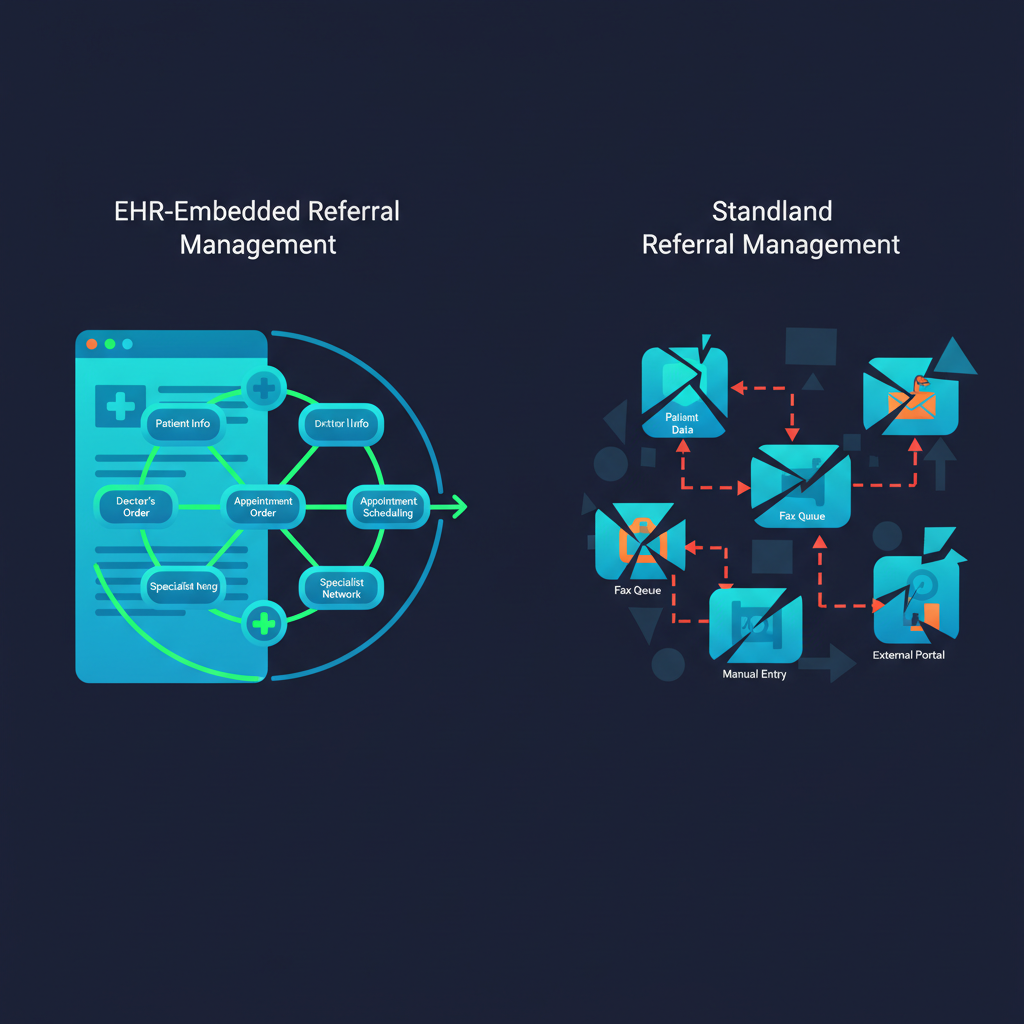 Referral Coordination
EHR-Embedded vs. Standalone Referral Management: What Healthcare Orgs Need to Know
Choosing between EHR-embedded and standalone referral management is one of the most consequential technology decisions a health system or medical group will make. Here's what actually separates the two — and how to evaluate which fits your organization.
Read article Analytics
The Hidden ROI of Automated Referral Coordination: A Framework for Health Systems
The ROI of referral management automation is real but notoriously hard to quantify — which is why most health systems underinvest. The ReferralPoint ROI Framework gives finance and operations leaders a structured way to measure what leakage, inefficiency, and prior auth friction are actually costing.
Read article AI & Automation
How AI Is Transforming Patient Referral Management in 2025
Artificial intelligence is no longer a future concept in healthcare — it's actively reshaping how medical groups, health systems, and payers manage patient referrals, reduce leakage, and improve outcomes.
Read article Prior Authorization
Prior Authorization in 2025: Why Automation Is No Longer Optional
Prior authorization delays are the single biggest cause of care delays and referral abandonment. AI-powered automation is changing that — and CMS mandates are accelerating adoption.
Read articleWant These In Your Inbox?
Practical playbooks on AI, automation, and referral economics — sent monthly.