
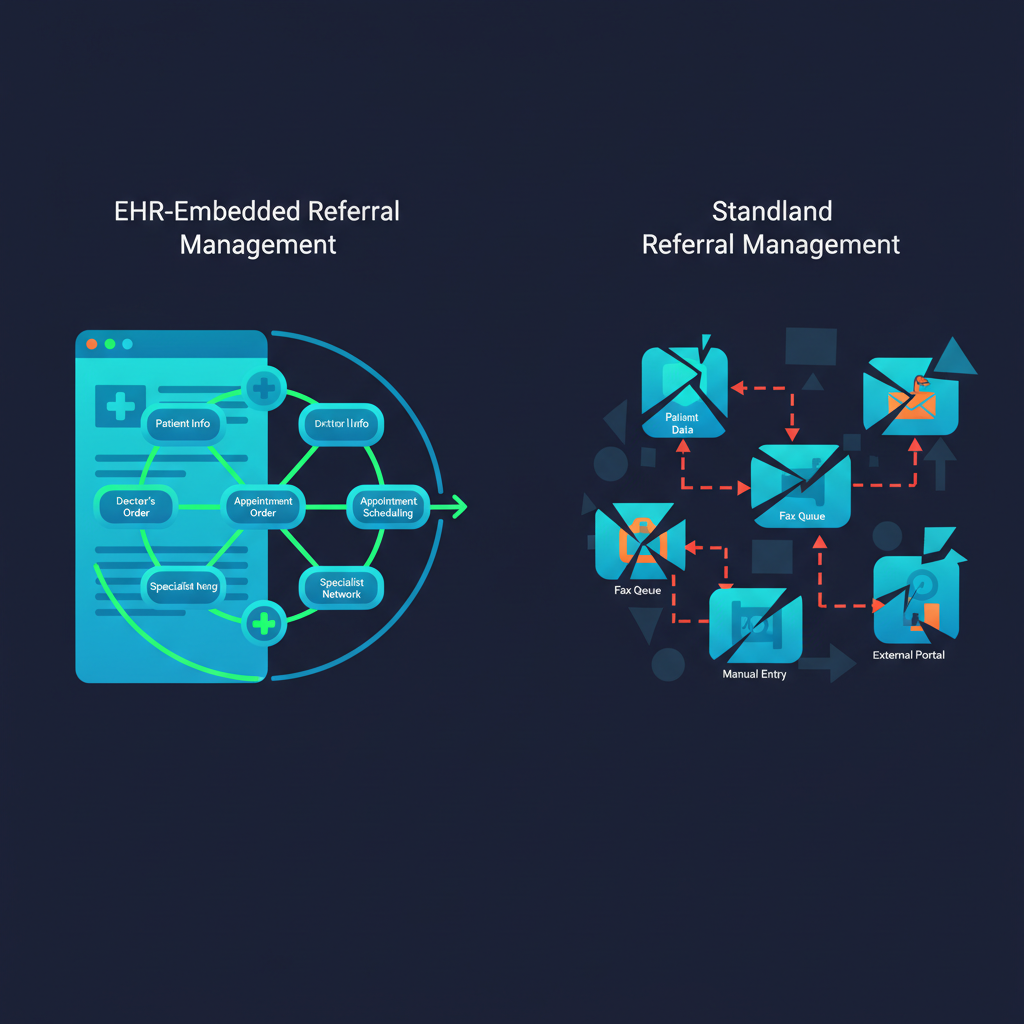
Choosing between EHR-embedded and standalone referral management is one of the most consequential technology decisions a health system or medical group will make. The right answer depends on your organization's size, complexity, existing infrastructure, and referral volume — but the architectural difference between the two approaches has real implications for adoption, data quality, and long-term ROI.
This is a genuine comparison. Both models have legitimate use cases. But for most mid-to-large healthcare organizations, the evidence points clearly in one direction.
Dimension 1: Workflow Integration
EHR-Embedded: Referral management lives inside the EHR where clinical staff already work. Orders trigger referral workflows automatically. No context-switching, no separate login, no duplicate data entry. The referral is part of the clinical record from the moment it's placed.
Standalone: Staff must leave the EHR, log into a separate application, and manually enter or import patient and referral data. Every transition between systems is a potential point of error and a source of friction that reduces adoption.
Verdict: EHR-embedded wins on workflow integration in virtually every scenario involving clinical staff. The friction of standalone tools compounds across thousands of referrals per month.
Dimension 2: Data Fidelity
EHR-Embedded: Clinical data — diagnoses, medications, insurance, prior visit notes — is already in the EHR. An embedded referral system uses that data directly, reducing transcription errors and ensuring the receiving provider gets complete, accurate information.
Standalone: Data must be exported, imported, or manually re-entered. Even with API integrations, data sync introduces latency and potential mismatches. What the specialist receives may not reflect the most current clinical picture.
Verdict: EHR-embedded. Data integrity is foundational to safe and effective referral care coordination.
Dimension 3: Staff Adoption
EHR-Embedded: Because the tool is part of the existing EHR environment, training requirements are lower. Staff don't need to learn a new system — they learn new functionality within a familiar one. Adoption rates tend to be higher, and the tool gets used consistently rather than sporadically.
Standalone: Requires dedicated training on a separate platform. Staff who are already managing high volumes of work resist adding another application to their daily routine. Standalone tools frequently see strong initial adoption that decays over 6–12 months as the novelty fades and the friction accumulates.
Verdict: EHR-embedded, particularly for high-volume referral teams.
Dimension 4: Total Cost of Ownership
EHR-Embedded: The licensing cost may be comparable to standalone, but the total cost of ownership is typically lower. Less IT integration work, lower training costs, fewer interfaces to maintain, and no secondary vendor relationship to manage.
Standalone: Lower upfront licensing cost in some cases, but integration fees, ongoing maintenance of EHR connectors, and the operational cost of workflow switching add up. For large organizations, the hidden costs of standalone frequently exceed the licensing savings within two years.
Verdict: EHR-embedded for organizations with significant referral volume.
Dimension 5: Prior Authorization Handling
EHR-Embedded: Prior auth can be triggered automatically at the point of referral order, using clinical data already in the chart. This is the only architecture that allows true simultaneous referral + auth initiation without duplicate data entry.
Standalone: Prior auth typically requires a separate step, separate data entry, or integration with yet another vendor. The coordination overhead increases significantly.
Verdict: EHR-embedded, decisively. The prior auth use case alone justifies the architectural difference for most health systems.
When Standalone Might Make Sense
To be direct: standalone referral management tools can work well for single-specialty practices with low referral volume, simple payer mix, and no prior auth complexity. If your team processes fewer than 200 referrals per month and your workflows are genuinely simple, a lightweight standalone tool may be a proportionate solution.
The complexity-to-capability mismatch is the real risk. When organizations outgrow their standalone tool — which typically happens faster than expected — the migration cost and operational disruption are significant.
What This Means by Organization Type
Health Systems: EHR-embedded is almost always the right architecture. The referral volume, care coordination complexity, value-based contract requirements, and network management needs of a health system require a platform that can operate at scale within existing clinical workflows.
Medical Groups: EHR-embedded wins here too, particularly for multi-specialty groups with complex referral patterns across multiple payers. Groups operating under capitation or shared savings arrangements need the visibility and completion tracking that only embedded tools provide reliably.
Community Health Centers: CHCs often have resource constraints that make simplicity attractive. But CHCs also typically have complex patient populations, Medicaid payer mix, and social determinants of health considerations that make referral completion rates a critical quality metric. EHR-embedded platforms give CHC staff the tools to close care gaps without adding administrative burden.
Questions to Ask Any Referral Management Vendor
- Does the tool operate inside our EHR, or does it require staff to switch applications?
- How is clinical data transferred — manual entry, API sync, or native access?
- Can prior authorization be initiated at the point of referral order?
- What does your implementation and training process look like for our EHR?
- How do you measure and report referral completion rates?
- What happens when our EHR updates — how are integrations maintained?
The answers will quickly reveal whether you're looking at a genuinely embedded solution or a standalone tool with an API wrapper.