
What Is Referral Leakage?
Referral leakage occurs when a patient is referred to a specialist or service but never completes that referral — either because they saw an out-of-network provider, fell through the cracks of a manual process, or simply never scheduled the appointment. Industry estimates suggest that 20–30% of referrals are never completed, representing a significant drain on health system revenue, network integrity, and patient outcomes.
The Four Main Causes
1. Manual, Fragmented Workflows
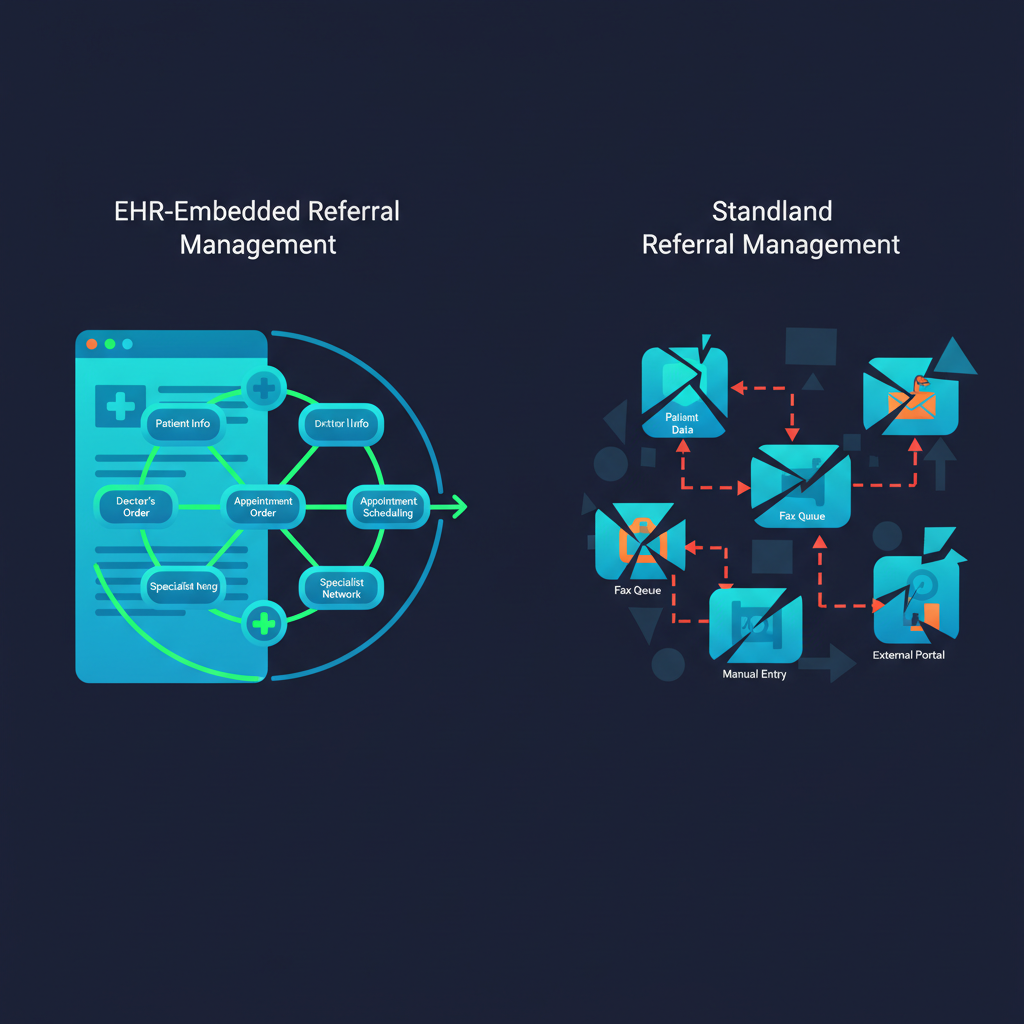
Most referral processes still rely on phone calls, faxes, and disconnected portals. When a referral coordinator has to leave the EHR to submit or track a referral, handoffs break down. A specialist's office misses a fax. A patient never receives a callback. The referral dies quietly, with no one the wiser until a claim fails to materialize.
2. Lack of Real-Time Visibility
If your team can't see — inside the EHR, in real time — whether a referred patient has scheduled, been seen, or cancelled, you can't intervene. Most health systems operate blind: they send the referral and hope. By the time leakage is discovered, the patient is already established with an out-of-network provider.
3. Prior Authorization Friction
Prior auth delays are a leading driver of referral abandonment. When authorization takes 10–14 days and requires multiple phone calls to a payer, patients disengage. Providers give up. The referral that was clinically indicated simply doesn't happen.
4. Inadequate Network Matching
When referring providers don't have easy access to in-network specialist availability, they default to whoever they know — which is often out of network. Poor network visibility at the point of referral is a structural leak that compounds over time.
What Does Referral Leakage Actually Cost?
The financial impact is substantial and largely hidden. Consider a health system processing 50,000 referrals per year. If 25% leak — a conservative estimate — that's 12,500 patients who complete their care outside your network. At an average downstream revenue of $1,500–$3,000 per referred patient episode, that's $18–37 million in annual lost revenue. For larger systems, the number scales dramatically.
Beyond revenue, there are patient outcome costs. Referrals that don't close often represent delayed diagnoses, unmanaged chronic conditions, and avoidable readmissions. For health systems operating under value-based contracts, leakage directly affects quality scores, risk scores, and shared savings distributions.
How EHR-Native Referral Management Closes the Leak
The most effective solution to referral leakage is closing the workflow loop inside the EHR — where care is documented, orders are placed, and clinical staff already work. When referral management is embedded natively, several things change:
Referrals are tracked automatically. Every referral has a status — sent, accepted, scheduled, completed, or cancelled — visible to the referring team without leaving the EHR.
Intelligent matching happens at the point of care. Instead of relying on a provider's memory of who's in-network, the system surfaces available, in-network specialists based on clinical criteria, insurance, and geography.
Prior auth is handled in parallel. Authorization requests are initiated automatically when a referral is placed, reducing delays and keeping the care episode moving.
Alerts close the loop. If a referred patient hasn't scheduled within a defined window, the system alerts the care team to intervene — before the patient is lost.
ReferralPoint is built specifically for this model. As an EHR-native platform, it operates inside your existing workflows without requiring staff to toggle between systems. The result is measurable reduction in leakage, faster care completion, and stronger network retention.
Start Quantifying Your Leakage
Most health systems don't know their actual leakage rate because they lack the visibility tools to measure it. The first step is establishing a baseline: how many referrals are placed, how many are completed in-network, and what's the average time to completion.
If you're ready to put a number on what referral leakage is costing your organization — and build a plan to recover it — ReferralPoint's Auto 360° VISIBILITY™ gives you that baseline in days, not quarters.
Frequently Asked Questions
Q: What is referral leakage in healthcare? A: Referral leakage is when a patient referred by their primary care provider or specialist never completes that referral, or completes it with an out-of-network provider. It results in lost revenue for the health system and potentially worse outcomes for the patient.
Q: How common is referral leakage? A: Industry estimates suggest 20–30% of referrals are never completed or are completed outside the referring health system's network, though rates vary significantly by organization, specialty, and referral management maturity.
Q: How do health systems reduce referral leakage? A: The most effective approaches combine real-time referral tracking inside the EHR, intelligent in-network specialist matching, automated prior authorization, and proactive outreach when referrals stall. EHR-native platforms like ReferralPoint address all four.
Q: What is the financial cost of referral leakage? A: It depends on referral volume and average downstream revenue per patient episode, but for a mid-size health system processing 50,000 referrals annually, leakage can represent $18–37 million in lost downstream revenue per year.